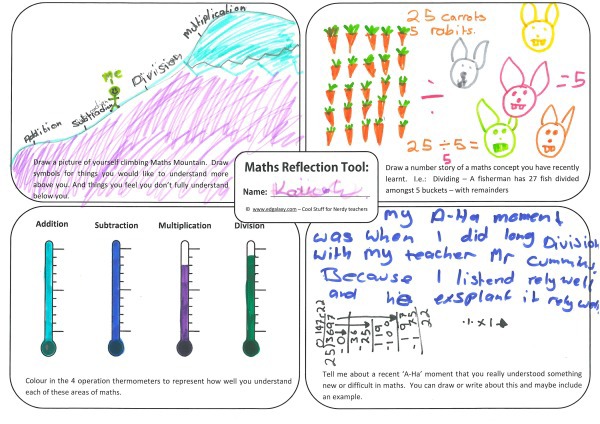
This assessment tool allows students to reflect upon and display their understanding of Algebra. You can download and edit the template to suit your needs as required.
I hope you enjoy it.
Free Maths Lesson Plans, Teaching Ideas and Resources for Teaching Numeracy and Mathematics
This assessment tool allows students to reflect upon and display their understanding of Algebra. You can download and edit the template to suit your needs as required.
I hope you enjoy it.
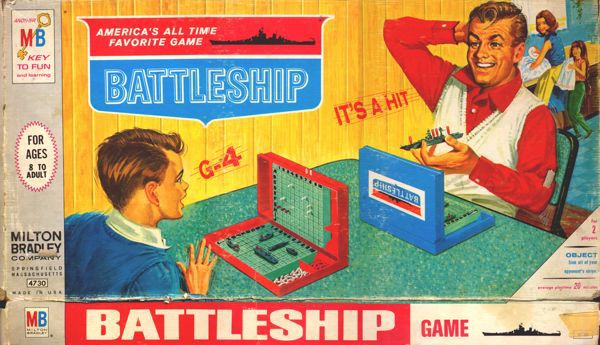
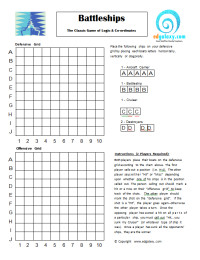
Battleship is a classic game of strategy and logic kids of all ages love to play. Best of all, it is a great to play in your maths class as it teaches students how to use acartesian planeand understand how to use co-ordinates on a grid.
I have made up two PDF versions of the classic battleship game you can download and print
The first one is thetraditional battleship gameand the second one is the slightly more advanced4 quadrant version of Battleshipwhich is more suited to secondary students.
"You just sunk my Battleship!"
Enjoy
It can be hard to find simple graph or grid paper when you need it in the classroom or if you are working at home. So I have made up a variety of common sized graph paper for you to download and use for FREE.
These can be used for a variety of maths, science or design purposes.
Please select the appropriate size below
Creating 3D shapes from a 2D net is a really important process for students to understand. It opens the door to discussing various aspects of geometry and looking at the properties of 3D shapes such as faces, vertices and edges.
This collection of 3D shape nets can be used in classes of all age groups to teach geometry and shape.
Simply select the shapes you want below, download, print and create. Enjoy!

Acing Math (One Deck At A Time!)is a collection of math games ranging from Kindergarten to the upper elementary grades, using only an ordinary deck of playing cards. There are games covering addition, subtraction, multiplication, division, fractions, percents, decimals, patterns, positive and negative integers, as well as many others.
A very wise old maths teacher who once taught me said that "You can teach every aspect of maths with a pack of cards" and this e-Book goes a long way to supporting that statement.
Enrico Fermi is the father of "solving maths problems we will never kown the exact answer to." Such as how many leaves are on all the trees in Central Park. They are great for getting students to think mathematically and use problem solving skills.
Fermi questions often require students to make reasonable assumptions and estimates about the situation in order to come up with an approximate answer. Students should be reminded of the need to be able to explain and justify what they did when coming up with their solutions. Students’ answers may differ from each other, but if students have made sensible estimates and assumptions then the different answers should be “close” to each other. Take advantage of opportunities to discuss students’ different solution strategies and the effect of assumptions and estimates. You can also invent your own Fermi questions based on class experiences (e.g., after a trip to the zoo you might ask students how many fish are consumed by the seals in one year).
1) How many people could you fit into the classroom? How many soccer balls?
2) How old are you if you are a million seconds old? A million hours old? A million days old?
3) Could you fit $1,000,000 worth of $1 coins in your classroom? What about a billion dollars worth of $1 coins?
4) How much money is spent in the school canteen each day? In a week? Over the year?
5) If all the people in Australia joined hands and stretched themselves out in a straight line, how long would it reach?
6) How long would it take to count to a million?
7) If all the people in the world moved to Victoria, how crowded would it be?
8) How many cups of water are there in a bath tub? What about in an Olympic pool?
9) How many grains of rice are in a 10kg bag?
10) How many pages would be needed to show a million stars?
**********
11) How many children are needed to have a mass the same as an elephant?
12) How many packets are needed to measure a single line of M&Ms to a distance of 100m?
13) How many jelly beans fill a bucket?
14) How long would it take to drive to the moon (if you could!)?
15) What is the total mass in kilograms of all the students in your school?
16) What is the weight of garbage thrown away by each family every year?
17) How many pizzas are eaten by our class in one year?
18) If you had a stack of $2 coins as tall as Mt Kosciusko, what would it be worth? Could you fit all the coins in your bedroom?
19) How far could you walk in one year?
20) How much water does your household use each week? Can you answer this without using a water bill?
21) How many blades of grass on a school oval?
22) Spend exactly $1,000,000 using things for sale in the newspaper
23) How much paper is used at our school each week?
24) Imagine the earth is at one end of the school oval and the moon is at the other end. How far away is the sun?
25) How many beats will your heart make in a lifetime?
26) How many bricks are there in one wall of the classroom? The whole school?
27) How many books are read by children in our school/class in one year? About how many pages is that?
28) What distance will a ball point pen write?
29) How many times did the wheel of the bus turn on the class
excursion?
30) How big a block of chocolate could you make using all the chocolate eaten by the class in a
year?
31) How long would our class have to save to buy a car?
32) Get students to pose their own
questions …
Sharing and discussing strategies is paramount to this work.
Some useful information:
Radius of the earth: about 6,400 km
Distance of the earth from the sun: about 150 million km
Distance of the moon from the earth: about 380,000 km
Population of the world: about 6 billion
Population of Australia: about 20 million
Population of Melbourne: about 3.5 million
Area of Tasmania: about 68000 square km
Area of Victoria: about 228000 square km
Area of Australia: about 7,700,000 sq. km
Height of Mt Kosciusko: 2230m
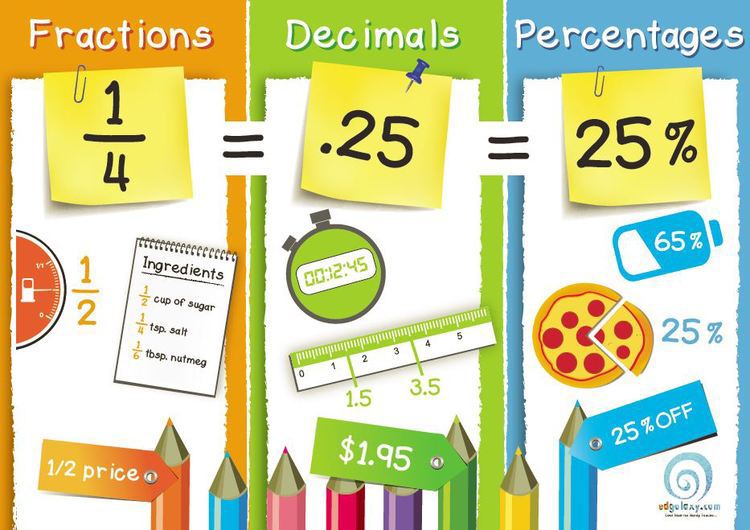
This Excel workbook is an excellent tool for using with your interactive whiteboard to explain the mathematical links between fractions, decimals ratios and percentages.
Here are some suggestions for how you might use it in the classroom.
How Many Shaded: Show the students the workbook with no red squares shaded and one or more of the fraction, ratio, decimal and percentage showing. Ask students how many squares need to be shaded to make 25% for example. Get one student to come to the board to add the squares to check. Repeat for different grid sizes and values.
Equivalent Fractions: Show the students the workbook with no red squares shaded and the fraction showing. Ask students how many squares need to be shaded to make 1/2 for example. Get one student to come to the board to add the squares, look at the fraction the click simplify to check. Repeat for different grid sizes, then for different fractions. Ask questions such as "Can we shade in 1/3 of the grid? If not why not?"
Investigate: In a computer lab, get the students to open up the workbook. Ask them to show the fraction and ratio cells and to investigate the relationship between the fractions and ratios for various grid sizes and a different number of squares shaded. Tell them that they can use the simplify button or calculator whenever they want. Tell them that they will have to write, present or discuss their findings. Ask the what the simplify button does, etc. This activity could also be used to investigate the relationship between fraction and decimal, etc.
Download it here.- Remember to Enable Macros to make it work correctly.
Thanks to Jenna from Wisconsin for sending me this great lesson plan involving maths and smarties. It has 20 maths problems that will challenge students of all ages involving number, shape, measurement and chance and data.
You can download the lesson plan here. And best of all when you are done, you get to eat the smarties.
Enjoy.